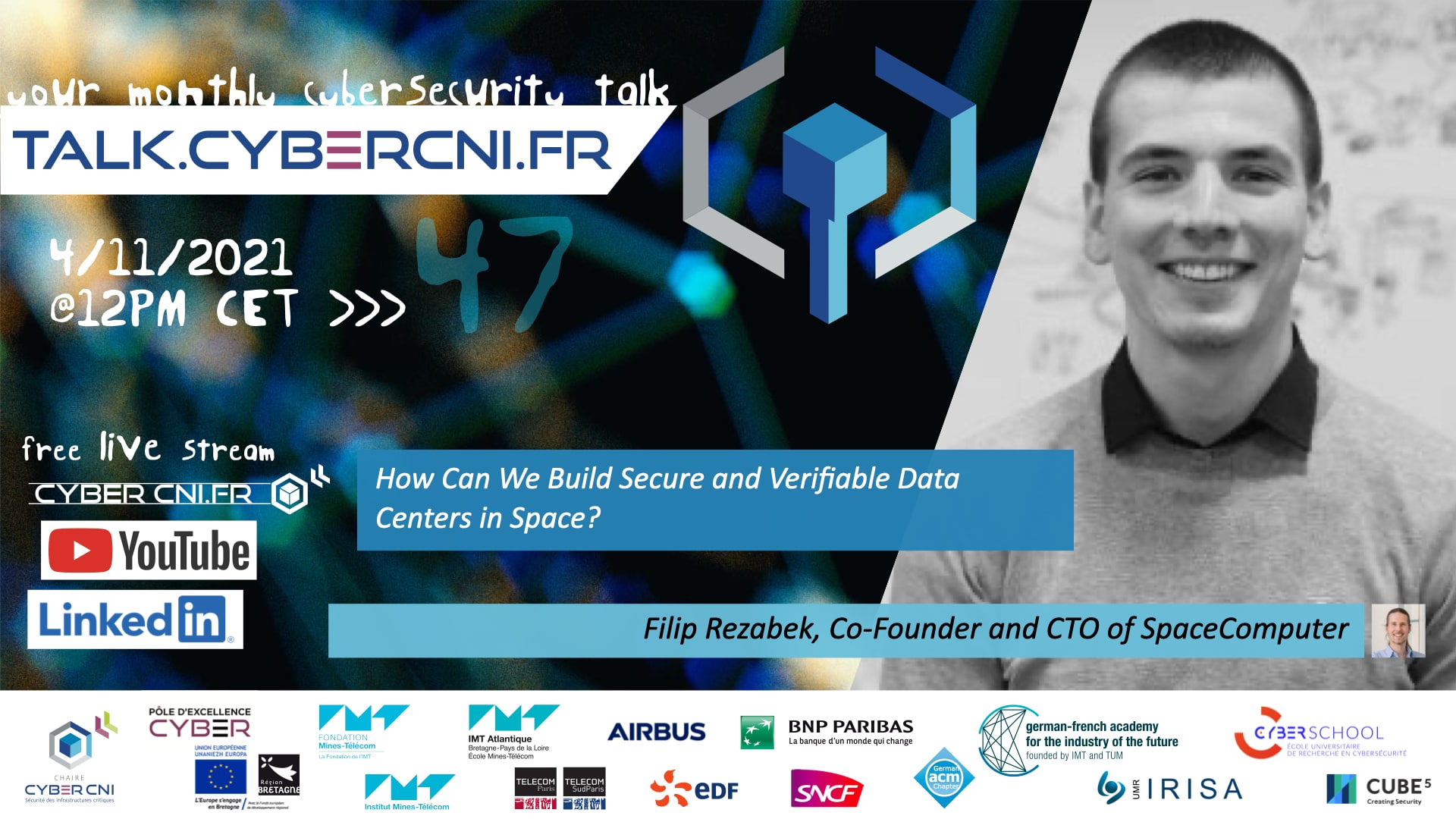
[T47] How Can We Build Secure and Verifiable Data Centers in Space? – Filip Rezabek
What if the next generation of data centers isn’t on Earth — but orbiting above us?
Satellites are evolving from communication and observation platforms into powerful, software-defined computing systems. Soon, they could execute AI workloads, process sensitive information, and provide shared computing services directly in orbit.
But this raises a fascinating cybersecurity challenge:
How can we trust a computer that we cannot physically access?
How can we verify which software actually executed, whether the hardware was compromised, and even where the computation took place?
On Wednesday, November 4, 2026, at 12:00 CET, we welcome Filip Rezabek, Co-Founder and CTO of SpaceComputer, for the 47th edition of the TALK.CYBER Lecture Series:
How Can We Build Secure and Verifiable Data Centers in Space?
Filip will introduce Space Fabric, an innovative security architecture designed to make orbital computing trustworthy and verifiable.
Combining trusted execution environments, independent secure elements, remote attestation, and distributed verification through ground stations, Space Fabric addresses fundamental questions about trust in computing environments that are physically inaccessible and potentially operated by third parties.
The architecture aims to provide cryptographic evidence of what was executed, on which hardware, and where — while supporting secure key generation after launch and reducing dependence on individual hardware vendors.
We will explore the prototype, its security guarantees, and the broader implications for confidential computing, distributed trust, and the emerging space economy.
And the questions extend far beyond space:
- Can we trust computations performed on infrastructure we do not control?
- How can remote attestation establish confidence in distributed systems?
- What happens when physical location itself becomes a security property?
- Could these approaches change how we design trustworthy computing infrastructures on Earth as well?
Join us for a free, interactive online lecture and discussion!
📅 Wednesday, November 4, 2026
🕛 12:00–13:30 CET (Paris/Berlin time)
🎥 Live on YouTube and LinkedIn
🌍 Free and open to everyone
🔗 Join the live stream: https://TALK.CYBERcni.fr/stream
Cybersecurity researchers, distributed systems experts, space technology enthusiasts, CISOs, students, and everyone interested in the future of secure computing are warmly invited.
Please share the invitation with your colleagues and networks!
Abstract
As satellites become more powerful and software-defined, they are beginning to support AI, data processing, and shared computing services directly in orbit.
However, this evolution creates a fundamental trust problem: customers need reliable evidence of what software executed, on which hardware, and whether the underlying system has been compromised.
This lecture introduces Space Fabric, a secure architecture for orbital computing developed by SpaceComputer.
The architecture combines trusted execution environments (TEEs), independent secure elements, remote attestation, and distributed ground-station verification.
Together, these mechanisms aim to provide cryptographic evidence of both what workload was executed and where it was executed, while enabling secure cryptographic key generation after launch and reducing dependence on any single hardware vendor.
Filip Rezabek will present the Space Fabric prototype, discuss its security guarantees and underlying architectural decisions, and explore how these mechanisms can enable secure, multi-tenant data centers in space.
The talk also raises broader questions about confidential computing, hardware trust, distributed verification, and the future of secure computing infrastructure.
How do we establish trust when computing moves beyond the physical boundaries of our planet?
Join us to explore this emerging frontier of cybersecurity.
About the Speaker
Filip Rezabek is Co-Founder and Chief Technology Officer of SpaceComputer, where he leads the design and development of the company’s distributed systems and cryptographic architecture.
He is also a researcher nearing completion of his PhD in distributed computing and robust systems.
His research spans computer networking, cryptography, trusted execution environments, and threshold-cryptography applications in blockchain systems, particularly cross-chain bridges.
Combining academic research with entrepreneurial innovation, Filip works on translating advanced security and distributed computing concepts into practical architectures for the emerging space economy.
Outside of research and technology, he enjoys hiking and listening to exactly the right amount of K-Pop.
About SpaceComputer
SpaceComputer is developing secure computing infrastructure for the emerging space economy.
Its Space Fabric platform integrates onboard hardware, confidential computing, remote attestation, cryptographic key management, and secure space-to-ground connectivity.
The objective is to transform satellites into programmable and trustworthy computing platforms capable of supporting AI, data processing, cryptographic services, and other sensitive workloads.
SpaceComputer’s long-term vision is to provide the trust layer for the emerging space internet.
About the TALK.CYBER Lecture Series
The TALK.CYBER Lecture Series is a free, international online event series bringing together researchers, industry experts, and the interested public to explore emerging cybersecurity challenges and technological developments.
Our goal is to make cutting-edge research accessible, encourage interdisciplinary exchange, and stimulate meaningful discussions between academia, industry, and society.
Each edition combines an expert presentation with an interactive discussion, streamed live on YouTube and LinkedIn.
Join the conversation. Research, question, discuss!
Program, upcoming lectures, and newsletter subscription: https://TALK.CYBERcni.fr/